

Modular vs. Single-Piece Bumpers: Which is Stronger for Off-Roading?
January 28, 2026
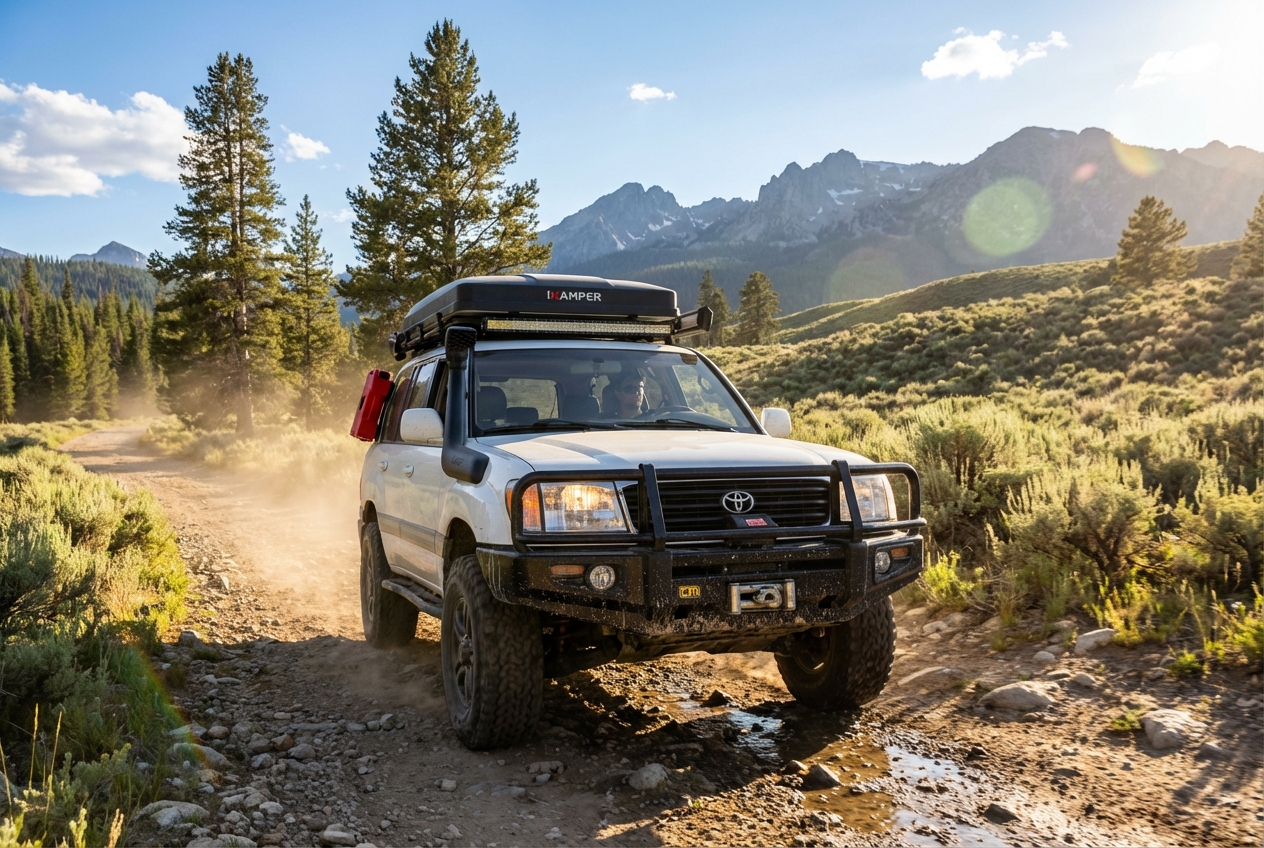
When you’re building an off-road rig, the front bumper is probably one of the first major upgrades you'll think about. It changes the look of your vehicle, sure, but its job is much more important than aesthetics.
Because off-road and overland vehicles face unique demands—like repeated vibration on washboard roads, sudden recovery loads, and the added weight of gear—the bumper takes a beating. If you’ve been browsing forums or online shops, you’ve probably noticed two main categories: modular bumpers (that come in pieces) and single-piece bumpers (fully welded units).
Most of the conversations focus on steel thickness or weight, but the construction method is arguably just as critical. The core question for anyone planning serious travel is simple: Is a modular bumper actually as strong as a single-piece design when you’re miles from pavement? Let’s jump in.
What Is a Modular Bumper?
A modular bumper is exactly what it sounds like: a bumper made of multiple steel sections that are bolted together during installation. These often arrive in a flat-packed box, similar to furniture, and require the owner or a shop to assemble the center section, wings, and bull bar (if applicable).
These bumpers have exploded in popularity for a few reasons:
- Shipping: It is much cheaper to ship a flat box than a massive, welded steel shape.
- Customization: You can sometimes swap out "wings" (short vs. full width) or add different hoop styles later.
- Mass Market Availability: They are easier for large retailers to stock and distribute.
It’s important to note that modular designs aren’t inherently "bad." For a daily driver that sees occasional trails, they offer flexibility and convenience. But the design prioritizes logistics and adjustability rather than maximum rigidity and strength.
Are Modular Bumpers Good for Off-Roading?
While modular bumpers are convenient, the very thing that makes them easy to ship—the bolts and seams—can become a liability in harsh environments.
Off-road travel exposes your vehicle to forces you don't encounter on the highway. Continuous vibration from corrugated roads is a major factor. Over thousands of miles, that vibration works away at fasteners. Even with thread locker and torque specs, bolted joints can loosen or shift, especially when the bumper is heavy and loaded with a winch.
Then there are recovery loads. When you’re stuck in mud or hung up on a rock, the forces applied to your winch or recovery points are massive. In a modular design, those forces have to transfer through bolted connections to reach the chassis mounts. This can create stress concentrations at the joints.
There’s also the issue of flex. A bolted structure generally has more "give" than a welded one. Under the twisting forces of uneven terrain or a heavy winch pull, a modular bumper may flex. Over time, this movement can cause squeaks, rattles, or even misalignment that isn't obvious during a quick parking lot inspection.
For lightweight vehicles, this might be negligible. But for heavy, fully-equipped overland vehicles, these small weaknesses add up.
What Defines a Single-Piece (Fully Welded) Bumper?
On the other end of the spectrum is the single-piece bumper. This is a continuous steel structure where the wings, center section, and mounting plates are fully welded together by the manufacturer.
Why does rigidity matter for a single-piece welded bumper?
The philosophy here is structural unity. The bumper is designed to distribute loads across the entire assembly rather than relying on fasteners to hold the shape together.
- Force Distribution: When you hit an obstacle or pull on a winch line, the energy is distributed more evenly through the welded structure and directly into the vehicle's frame.
- Less Maintenance: There are no bolts holding the wings on that you need to check after a long trip.
- Durability: A welded joint, when done correctly, effectively turns multiple pieces of steel into one solid unit. It eliminates the weak points associated with bolted seams.
Why Single-Piece Welded Bumpers Are Better for Overlanding
Overlanding is different from weekend driving. You aren't just popping over a few rocks and driving home; you are living out of your vehicle, often heavily loaded with fuel, water, and gear, for days or weeks at a time.
In this context, reliability is king. A rigid, single-piece bumper effectively becomes an extension of the vehicle’s chassis. It provides a solid platform for winching without the worry of the bumper twisting or bolts shearing under extreme stress.
Vehicles like the Toyota Land Cruiser are often used as the benchmark for this type of travel because they represent the upper end of weight and durability. If a component can survive on a fully loaded Land Cruiser crossing a desert, it’s likely over-engineered for almost anything else.
Fit, Finish, and Long-Term Ownership
Beyond raw strength, there is the ownership experience. Anyone who has assembled a complex modular bumper knows that getting the panels to align perfectly can be a headache. Gaps can be uneven, and over time, if the bumper shifts, those gaps can change.
Single-piece bumpers typically offer a much cleaner aesthetic. The lines are tight, the finish is consistent, and the unit looks like it belongs on the vehicle—an "OEM-plus" appearance that integrates with the truck’s design rather than looking like a bolt-on afterthought.
For the owner, this means fewer crevices for mud and salt to hide in (corrosion hotspots) and fewer fasteners to worry about rusting or seizing. It’s a "install it and forget it" solution.
Why Long Range America Recommends The Cruiser Company
At Long Range America, we understand the needs of long-distance travelers. This is why we partner with The Cruiser Company for our bumper offerings.
The Cruiser Company’s single-piece bumpers prioritize structural integrity above shipping convenience. Their designs are proven on heavy, expedition-ready platforms that demand the absolute most from their equipment. The engineering philosophy aligns perfectly with long-distance overlanding standards: build it strong, build it right, and build it to last.
Conclusion: Are Modular or Single-Piece Welded Bumpers Better?
When you’re choosing armor for your vehicle, you are making a choice between convenience and absolute structural integrity.
Modular bumpers have their place: they’re accessible and customizable. But if your goal is serious off-road use, remote travel, or building a rig that can handle heavy recovery loads without flinching, the construction method matters.
A single-piece, fully welded bumper offers superior rigidity, better load distribution, and a maintenance-free lifespan that modular units struggle to match. In off-roading, true strength comes from how a bumper is built—not just how many pieces it comes in.
Shop yours today at longrangeamerica.com.